The grantmaking landscape is evolving faster than ever. 2025 grant trends are doing the most, to say the least. With public funding in flux, private foundations shifting priorities, and technology changing how proposals are crafted and reviewed, nonprofits need way more than strong writing to stay competitive.
Whether you’re leading a small team or juggling grants solo, now is the time to step back, assess the big picture, and recalibrate for what’s ahead. In this article, we break down the most prominent 2025 grant trends and show you how to future-proof your strategy, so you’re not just reacting, but adapting with confidence.
5 Key Nonprofit Grant Trends Reshaping 2025
1. Trust-Based Philanthropy Is Growing—and Getting More Structured
The shift toward trust-based philanthropy continues to redefine nonprofit–funder relationships in 2025. While originally centered around principles like unrestricted funding and reduced administrative burden, this approach has evolved. More foundations are now embedding trust-based principles into formal structures. This includes multi-year commitments, grantee feedback loops, and shared accountability frameworks.
What used to be a niche movement is now shaping mainstream philanthropy. Funders acknowledge the power imbalances inherent in traditional grantmaking and seek deeper partnerships built on mutual respect, honesty, and shared goals.
For nonprofits, this means less time spent proving worth through excessive documentation and more focused on delivering impact. But it also means showing up with integrity, transparency, and consistent communication.
What to do:
- Invest in relationships all year long. Reach out between grant cycles with meaningful updates, even when not asking for money.
- Be honest about your challenges. Funders appreciate organizations that own their learning curves and talk openly about what’s working—and what’s not.
- Create a “trust agreement.” This could be a one-page mutual expectations document outlining how you’ll communicate, report impact, and share feedback over time.
- Use narrative reports to tell real stories. Go beyond metrics to show what you’ve learned and how you adapt your programs.
Pro tip: Schedule quarterly “funder touchpoints,” even if they’re not requested and are just a short email or call. These practices build connections, keep your organization top of mind, and demonstrate a collaborative spirit that funders are increasingly looking for.
2. AI Tools Are Reshaping Grant Writing and Reviewing
At Grant Writing Made Easier, we’ve been championing responsible AI use since 2023, and the 2025 grant trends are underscoring that this trend isn’t going anywhere. We’ve used it in our work and with nonprofit organizations we work with, and we’ve seen firsthand how powerful (and practical) it can be. From eliminating writer’s block to generating compelling evaluation plans, AI is helping nonprofits save time and level up their writing quality.
AI tools like ChatGPT, Grammarly, and Notion are now standard in nonprofit offices. They’re assisting with everything from content drafts to summarizing impact data. Some funders are experimenting with AI to pre-screen applications based on clarity and alignment.

But, of course, there’s a catch: AI can accelerate content creation, but if unchecked, it often introduces robotic tone, factual inaccuracies, or subtle bias. Not to worry, though, because we have plenty of resources to support your AI-supported grant work so that you can work smarter. Used effectively, AI tools are one of the primary ways that small and/or underresourced nonprofits can level the playing field and bust through the industrial nonprofit complex.
What to do:
- Use AI as your copilot. Let it help you brainstorm, outline, or rephrase, but always revise with your mission, tone, and goals in mind.
- Create internal AI guidelines. Clarify what AI can draft (like boilerplate sections or budget rationales) and what must stay human-led (like personal stories or your theory of change).
- Verify everything. Always fact-check AI-generated content. Never copy-paste without confirming the data, source, and voice.
- Write for both humans and machines. Make your proposals clear, structured, and scannable to meet the needs of AI-assisted funder review processes.
Want to implement AI the right way? We’ve got you covered.
Explore our hands-on resources designed to help small nonprofit teams build innovative, ethical AI-powered grant systems to stay on top of 2025 grant trends:
- Intro to Grant Writing with AI– Our self-paced course gives you 3 hours of training on how to use AI to outline, draft, revise, and finalize your next grant with confidence. Includes a 90+ page workbook and copy-paste prompts tailored to real nonprofit scenarios.
- Free 7-Day Challenge – Learn and implement our exclusive framework to write stronger grants in less time. Perfect if you want to test the waters and build good AI habits immediately.
Both options walk you through exactly how we use AI, how you can make it work for your team, and how to implement AI tools without sacrificing strategy, ethics, or your organization’s voice.
3. Funders Expect Clearer, Stronger Impact Measurement
The demand for measurable impact is one of the most significant 2025 grant trends, as funders increasingly expect nonprofits to demonstrate outcomes with clear, data-driven results. Funders want more than passion or compelling stories—they want proof that your programs deliver results. This means proposals must clearly articulate how success is defined, measured, and reported.
Vague claims like “we help our community thrive” aren’t enough. Funders want to see SMART goals (Specific, Measurable, Achievable, Relevant, Time-bound), robust evaluation plans, and transparent reporting processes. They also value data that speaks to long-term change, not just one-time outputs.
What to do:
- Design your programs with evaluation in mind. Create mechanisms to collect data from the start, not as an afterthought.
- Use a mix of quantitative and qualitative data. Numbers show the scale, but stories show the depth.
- Highlight systems for tracking. Funders want to know how you measure impact, not just that you do.
- Prepare logic models or theory of change diagrams to demonstrate how your activities lead to visual outcomes.
Example: Instead of saying “our employment program helps participants get jobs and keep their jobs,” say: “In 2024, 87% of participants gained employment within 60 days of graduation, and 92% remained employed after six months. Our follow-up surveys indicate improved household income and job satisfaction.”
4. Cross-Sector Collaborations are Becoming the New Norm According to 2025 Grant Trends
More funders seek collaborative proposals demonstrating a shared commitment to solving complex issues. Whether nonprofits work with schools, healthcare systems, local governments, or businesses, cross-sector partnerships are increasingly seen as essential to scaling impact and avoiding duplication of services.

Reflecting key 2025 grant trends, this shift moves nonprofits away from siloed service delivery and toward ecosystem-level solutions. As a result, funders increasingly expect to see cross-sector collaboration—clearly defined partnerships, shared responsibilities, and unified outcomes that demonstrate collective impact.
What to do:
- Build intentional partnerships early. Don’t wait until an RFP requires collaboration—invest in relationships before the need arises.
- Define roles and responsibilities clearly. Use MOUs or joint work plans to outline how each partner contributes.
- Track and share collective impact. Use shared evaluation tools to demonstrate the total value of the partnership.
- Highlight coordination, not competition. Funders want to know you’re solving problems together, not overlapping services or competing for the same outcomes.
Example: Instead of a standalone after-school program, your organization partners with the local school district and a mental health provider. Together, you offer academic support, mental wellness services, and family engagement under one initiative and, subsequently, one grant proposal. Your proposal includes a joint theory of change and a unified data dashboard.
5. DEI Remains Central in Private Funding—Despite Public-Sector Pushback
In 2025, DEI (Diversity, Equity, Inclusion) remains a central theme in private foundation funding, even as some public and state sources are rolling back DEI language or funding. Most private funders are doubling down on their DEI focus, requiring clear equity-centered strategies and genuine community engagement in their grantees.
This makes DEI more than just a buzzword. DEI is a lens for program design, leadership, storytelling, and evaluation. Grants that authentically address systemic inequities often stand out in today’s competitive landscape.
What to do:
- Do your homework on funders’ DEI stances. Some prefer explicit DEI language, and others may shy away. Adapt phrasing, but don’t dilute your equity goals.
- Use disaggregated data to demonstrate equity focus. Go beyond “we serve diverse communities” and show how your program serves women, BIPOC, rural, or LGBTQ+ populations with targeted outcomes.
- Center community voice. Funder expectations now often include demonstrating lived experience leadership, co-creation, and community-driven evaluation.
- Elevate organizational-level practices. Showcase practices like diverse board recruitment, equity training, inclusive hiring, and antiracism policies—not just program equity outcomes.
GWME’s DEI approach:
As part of our mission, Grant Writing Made Easier champions equity-centered design, from internal policies to services provided to nonprofits. We help clients:
- Choose respectful, culturally relevant language
- Collect and report demographic and equity-focused data
- Highlight authentic community co-creation and shared leadership
Why this matters now: Many nonprofits lack DEI capacity, even “unintentionally.” A competitive advantage comes from embracing DEI as both an internal priority and a proposal centerpiece. That means discussing how your leadership reflects your community, how your program adapts based on participant feedback, and how your ongoing evaluation supports equitable access.
What 2025 Grant Trends Mean for the Nonprofit Sector
The landscape of grant funding is undergoing a profound transformation. More importantly, these shifts aren’t merely stylistic—they’re structural. As a result, funders are increasingly signaling a desire for deeper relationships, stronger evidence of impact, and more meaningful commitments to equity and collaboration.
Grant writing is no longer just about strong narratives. Now, more than ever, it’s about aligning your strategy, values, and operations with where funding is headed.

How Nonprofits Need to Evolve:
- Shift from transactional to transformational communication. Don’t just show up when the RFP drops. Build year-round rapport with funders through thoughtful updates, questions, and shared goals.
- Make data your development ally. Show that you understand how and why your work matters through stories and numbers.
- Invest in collaboration. Whether you’re partnering across departments or sectors, funders want to see collective impact and shared learning.
- Make grant strategy a team sport. Empower your staff to support grant readiness, even if you have only one grant writer. Budget data, program outcomes, and stories live across your org, not just in development.
Recommended Organizational Shifts
To keep pace with emerging expectations, consider these practical ways to evolve your grant strategy and culture:
- Build relationship-centered practices. Send quarterly check-ins or brief updates to top funders. Share successes, upcoming projects, or even lessons learned.
- Adopt responsible AI tools. Use them to accelerate brainstorming or formatting, but always maintain a human tone and ethical guardrails. Document a clear use policy.
- Embed equity and inclusion. Audit your grant content and practices. Ensure your narratives elevate lived experience and your data reflects who you serve.
- Upgrade evaluation capacity. Start tracking outcome metrics early in your program cycle—not just when the grant requests it. Consider training staff in basic data storytelling and logic models.
Pro tip: Treat your grant strategy as a living document. Revisit it each quarter to reflect new insights, shifts in funder focus, or internal learning.
Utilize 2025 Grant Trends to Future-Proof Your Funding Strategy
As we move through the second half of 2025, nonprofits face both uncertainty and opportunity. In this evolving landscape, the most successful teams aren’t necessarily those who work the hardest. Instead, they are the ones who work smarter, align closely with funders, and commit to continuous learning.
Ready to elevate your grant readiness?
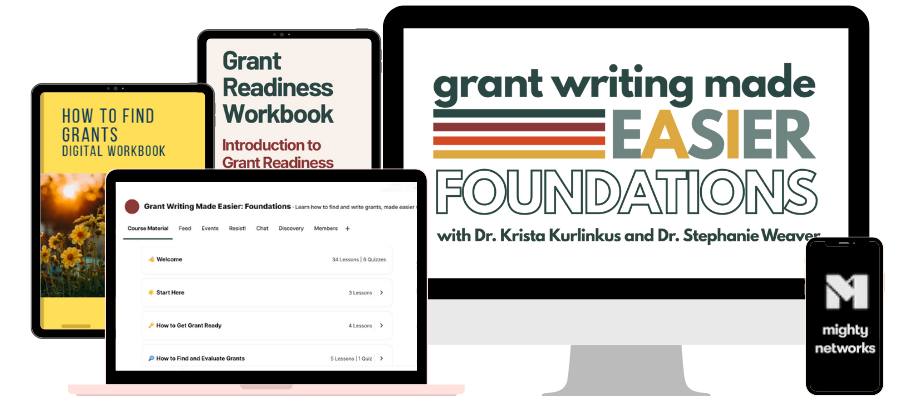
Inside Grant Writing Made Easier, you’ll find tools, templates, and trainings—designed for small teams and solo funders—to build smarter, more sustainable, and less stressful grant systems.
If you’re ready to:
- Build grant systems that reduce stress and guesswork
- Strengthen your proposals with better data and storytelling
- Align your internal practices with the latest funder trends…
Our course and community are built for small teams, solo fundraisers, and organizations ready to write smarter, more sustainable grants.
Let’s make the second half of 2025 your strongest yet.